

Berry Bros. & Rudd in the USA: more than a century in the making
Written by

I have recently been delving into the Berry Bros. & Rudd archives with a keen interest in our dealings with the USA. What exists of an historic “special relationship” with the USA? Some consider that Cutty Sark whisky is still our greatest transatlantic export. But from what I've been able to find in our archives, there's plenty more to it.
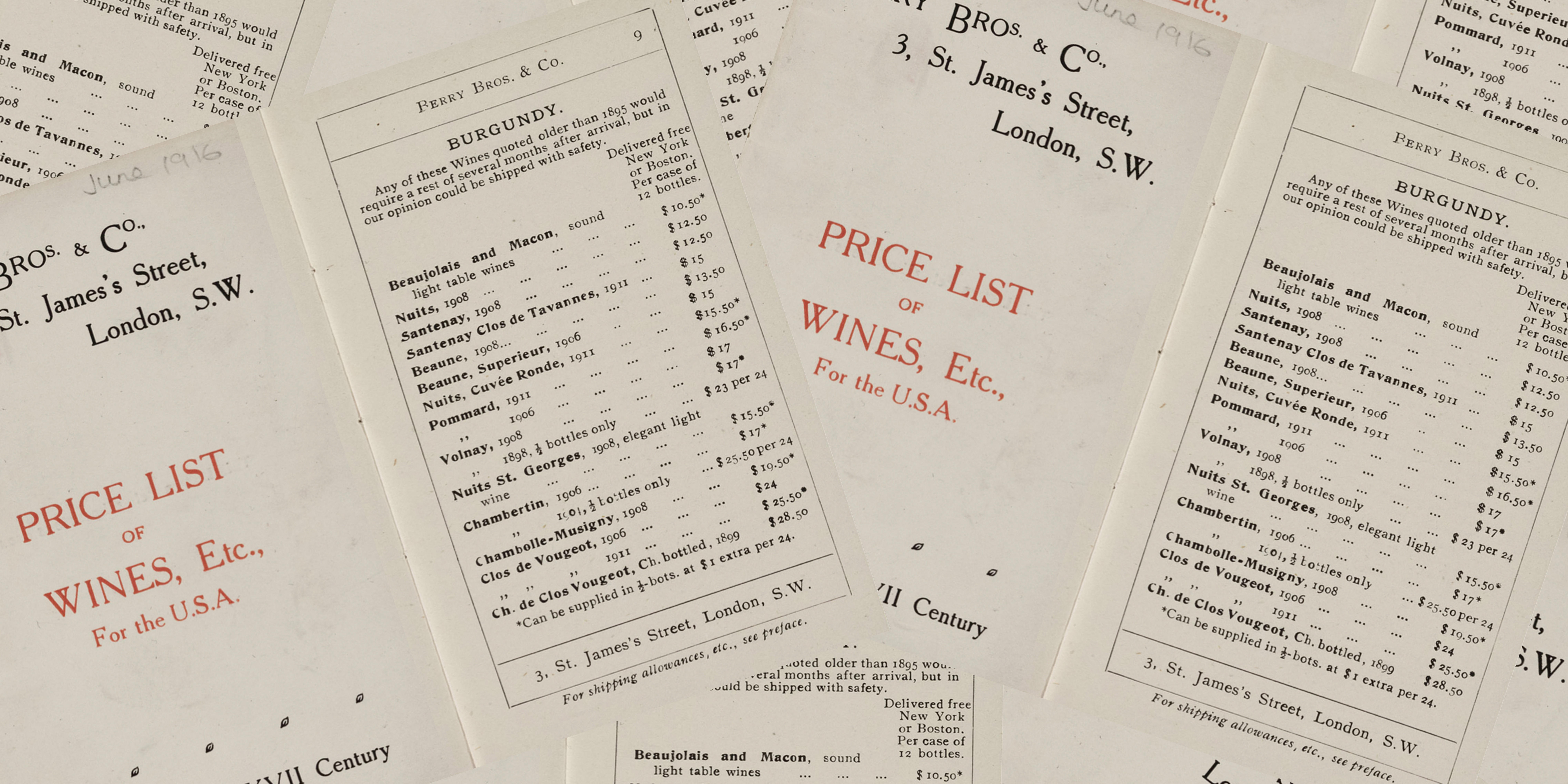
And what I found is a Berry Bros. & Rudd price list from June 1916, made specifically for the USA. Indeed, its official title is “Price List of Wines, Etc. for the U.S.A”. I wonder how the spirits industry today would look upon being referred to as mere “Etc” in the previous century.
It’s hard enough shipping wines and spirits today, even with the advent of air freight, chilled reefers and next-day delivery. It certainly can’t have been easy back in 1916. Orville Wright had only taken to the skies (for 12 seconds) 13 years previously and the motor car was barely 30 years old in 1916.
But the 1900s was the glamorous age of the transatlantic liners. These floating towns would transport international tycoons on business trips, immigrants seeking a new life and of course, sought-after and treasured goods for export. Think RMS Lusitania, RMS Queen Mary and the tragic RMS Titanic – the latter with which we have our own link.
On 16th April 1912, just two days after the Titanic was lost, Berry Bros. & Rudd received a telegram from The White Star Line alerting us to the loss of our shipment on board. In a 1977 issue of No.3 Magazine, we printed a copy of this telegram with a somewhat cutting caption observing that “within 48 hours of the disaster we – and presumably all other shippers involved – received accurate confirmation of the freight loss. In today’s world, with all its modern methods and communications, such precise and speedy information would seem miraculous.”
It is that same “speedy” transatlantic communication and transit which we were making the most of with our 1916 price list. The prices quoted also included free delivery “in New York or Boston (either at residence or on rail), or any place within 50 miles of New York or Boston.” Impressive terms, indeed.
Delving into the contents of the list, there are the usual suspects one might spot in the modern day: Burgundy, Champagne, Port, Sauternes, whisky. Taking Burgundy as an example, it is interesting that no producer is listed against any of the wines. Poor Beaujolais and Mâcon are summarised as “sound light table wines” while other highlights include a 1911 “Nuits, Cuvée Ronde” and a 1906 Chambertin. If only we’d mastered time travel.
It's advised throughout the list that the wines “would require a rest of several months at least on arrival”. This would allow the temperature to restabilise, any sediment to settle and for the recovery of bottle shock – when wine’s flavours become muted or negatively disturbed, temporarily.
You might well have noticed the date of this price list falling right in the middle of the First World War. There is a rather poignant nod to this on the page listing Tokaji and Hungarian wines. Firstly, advice is proffered that “[Tokaji Essenzia] are the only Wines that should be kept standing up.” This was due to the high acidity of these wines which could cause the cork to disintegrate if they came into contact for too long. But the poignant note is that of our stock of [Tokaji Essenzia] in England already being exhausted “and it will be impossible to replace it until after the war”. Hungary was devastated by immense military losses and reduced territories in World War One.
Not as commonplace today, Chartreuse has a page of its own in our 1916 list. Here, it is “Guaranteed made by the Chartreuse Monks at their Monastery previous to their expulsion from France.” This refers to 1903 when the French “Association Law of 1901” enforced numerous laws against religious associations, with many of them having to close. The exiled monks of Chartreuse relocated to Tarragona in Spain where they produced Liqueur fabriquée à Tarragone par les Pères Chartreux.
Any Chartreuse afficionado reading this will be delighted to hear that we were offering the stuff in green, yellow and white form. Helpfully, our old list suggests that “Green and White Chartreuse mixed in equal parts form an excellent substitute or alternative to Yellow Chartreuse”. Any art teacher worth their salt would tell you that.
Sensibly so, our price list of 1916 includes “Terms, Arrangements & Suggestions”. In the era before temperature-controlled transit, we would “make our shipments chiefly in the spring and early summer and in the autumn, and it is very rarely indeed that any of our wines are damaged.”
We close by declaring that “Recommendations by our customers to their friends are highly appreciated by us – it is our only method of advertisement.” While the latter part of this statement no longer applies, the former certainly does. After a century in the making, we look forward to welcoming a new set of customers to our Washington Shop.



