


Pickering Place: The Duel between fact and fiction
Written by

As Mark Twain so famously wrote, “Never let the truth get in the way of a good story”. While he was most likely referring to the written word, his well-worn phrase has been used to cloak many a historical tale in mystery.
Like much of old London, our own little corner of St James’s Street has a bulging collection of tales, myths, legends and of course, fact surrounding it. Nowhere more so than London’s smallest public square, Pickering Place.
From tennis to Thomas Stroud
The land now occupied by Pickering Place was once part of Henry VIII’s real tennis courts – annexed to his residence at St James’s Palace. Over time, this space has evolved from tennis to tastings here at Berry Bros. & Rudd. Some sources claim it was Oliver Cromwell who dealt the first blow to the tennis court, the sport not sitting well with his puritan ideals.
According to H. Warner Allen in his history book, Number Three Saint James’s Street, Pickering Place was referred to as Stroud Court in a 1731 Building Agreement. It was named for Thomas Stroud, the first known resident of No.3 and the builder of many of the houses which enclose what is now Pickering Place. By 1741, it was named as Pickering’s Court, after William Pickering had taken ownership and redesigned some of its layout. By 1812, it was Pickering Place.
A den of iniquity
When the Palace of Whitehall burned down in 1698, the Royal Court moved to St James’s Palace. London society followed and this is when St James’s and the surrounding area became a “well-to-do” and respectable part of London.
Despite its new high society, Pickering Place was a hotbed of illicit activity during the 18th century. Surrounded by tall buildings and with dark corners to hide unscrupulous activities, it was renowned for gambling, bear baiting, cock fighting, bare-knuckle boxing and duelling. Beau Brummell, a bon vivant well known in the area (and a customer of ours) is even rumoured to have participated in a duel here. Given the chap notoriously took five hours to get ready every day, I can scarcely believe he would have found the time. Other rumours suggest there was even a brothel.
Notable residents
Any modern-day visitor to Pickering Place would consider it a highly desirable place to live. It’s an estate agent’s dream: central location, tucked away off one of the most coveted streets in London, delightfully quiet for such a well-connected part of the city and so on. Sadly for our property-touting friends, none of the houses here have been residential since about the mid-1980s. I have heard that the rooms which now make up our Townhouse dining room and its Georgian Green Room (both overlooking Pickering Place) were last rented by a lady with two exceedingly large and equally dribbly dogs.
Pickering Place has been home to some rather-more notable residents than “Fido” and “Rex” (which may or may not have been their real names). As a relatively frequent visitor to our premises, Beau Brummell is rumoured not only to have duelled, but also to have taken residence in Pickering Place. As lovely and full circle as this would be, it is thought that this rumour is merely the result of Brummell’s presence in the surrounding area and also, in our weight ledgers.
Another reputed resident was two-time Prime Minister Lord Palmerston. As yet, I haven’t found any proof that His Lordship ever lived here and certainly no record of which number house he lived in. I think I have a pretty good idea where this rumour might have stemmed from.
As you emerge from St James’s Street into Pickering Place, one of the first things you see on the other side of the square is a relief bust of a Victorian gentleman. Complete with tied cravat, buoyant hair and perfectly-period sideburns, this stone tablet supposedly depicts – you guessed it – Lord Palmerston.
There is very little likeness between the bust and Lord Palmerston; it looks more like President Lincoln to me. This might support the other, more likely, rumour which surrounds this bust. According to some sources, it is nothing to do with Lord Palmerston. It was simply left behind when an antique dealer vacated premises in the early 20th century and couldn’t be bothered to take it with them.
Known for writing Our Man In Havana, Graham Greene was “our man in Pickering Place” at one time. Not only did he live here but he used it as inspiration in some of his work: in The Human Factor, Colonel Daintry lives in a two-room flat in the square.
Dark times at Pickering Place
Even Pickering Place has been touched by some of the darker periods in the nation’s history. A poignant reminder of this is a photograph taken there, dated September 1914. At first glance, it’s a seemingly normal post-Edwardian image of gentlemen in boaters, flat caps and the odd bowler having some sort of gathering. As you look closer, tables, paper and the signing of signatures become clear. These men are all answering the call from a recruitment poster to join the 11th Battalion of The Royal Fusiliers.
The poster in question listed No.3 St James’s Street as the “Recruiting Office”. According to the book of our history, Berry Bros. & Rudd, the poster “was taken down afterwards and, still with the staple-marks in its corners, rolled up with a couple more and put at the back of a drawer in the Parlour at No.3.”
The book gives a brief service record of the 11th Battalion of The Royal Fusiliers. Formed as part of Kitchener’s (initially) volunteer army, the Battalion arrived in France in the summer of 1915. Its men served on the Western Front until 1918, their time on the continent including the hideous Battle of The Somme.
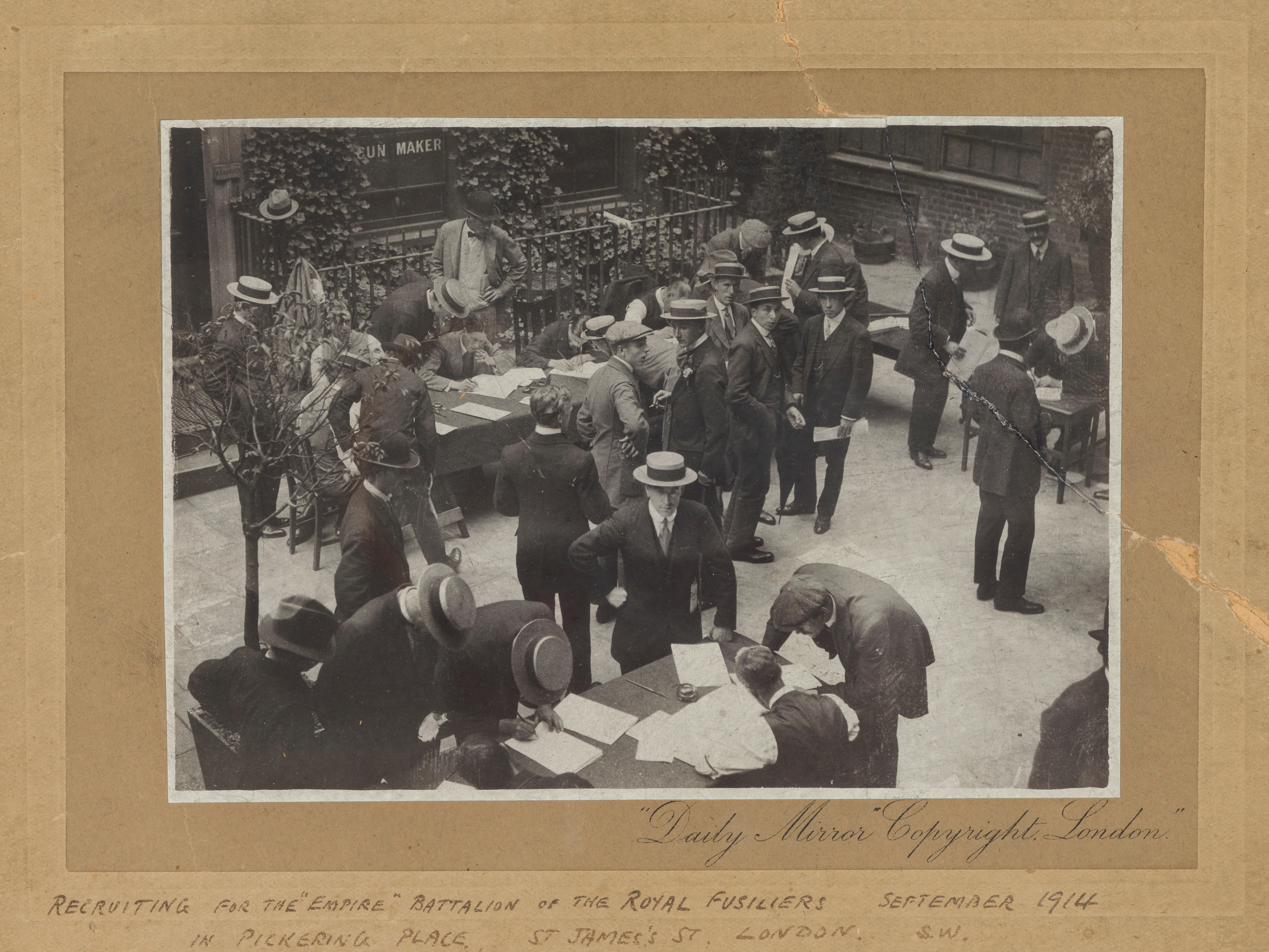
Signing up in Pickering Place
And so to the duel
As the bleak days of the First World War began to pass, the Roaring Twenties exploded and with them, the age of the “talkie” moving picture. Long before the home of Berry Bros. & Rudd featured in Kingsman: The Golden Circle (2017), it appears we had already dabbled with cinema at the dawn of its new, auditory age.
In our archives, we have a collection of photographs taken in Pickering Place (dated May 1922). They depict five gentlemen in 18th-century dress, two of them duelling with swords. One of the photographs even sees the losing combatant lying, supine, on the flagstones of the square. Written on the back is “[Unreadable] Film Co. Cinema film in the making of a Duel piece in Pickering Place, St James’. Photo by Francis Berry.”
An accompanying newspaper cutting from The Times, dated 3rd June 1922, features one of the photographs, captioned “Duelling in the Georgian days as enacted for an educational film, dealing with the less known parts of the history of London in Pickering place old courtyard S.W.”
The Duel whiskies
Whether it was the 1922 filming or earlier whisperings which started it, there has long been a rumour that the last duel fought in London occurred in Pickering Place. As the adage goes, this has never been proved, but nor has it been disproved. It is this myth which forms the tale behind our duo of whiskies, The Duel. It’s seen as a battle between the two liquids, Justice and Honour.
With murky details and tales lost to the passage of time, you can fill the blanks in for yourself. Who were the combatants? What were they duelling over? Who emerged victorious? In the case of the two whiskies, you can crown your favourite as the victor.
Sadly, it is highly unlikely that the last duel fought in London was held in Pickering Place. For a start, duelling by sword was eventually superseded by duelling with pistols. In a space as small as Pickering Place a “pistols at dawn” duel, with each combatant taking 10 paces before taking aim, would have been impossible – nor would it have been particularly sporting to use ballistics at such close quarters.
Secondly, there are numerous sources which state the last London duel took place in a field near Camden in 1843. Those sources come complete with the names of the duellists while the Pickering Place battlers always remain nameless.
But “unlikely” doesn’t mean “untrue” and that is part of the romance of Pickering Place. This small, slice of historic London, still lit by gas even today, gives you the freedom to write much of the story yourself. Better yet, the next time you visit, you can play your own starring role in the history of Pickering Place. And that is a fact.



