

Through the photographer’s lens
“Hello, am I speaking with Mr Krystian?”
“Yes, this is he.”
“I’m calling from the photographic lab. I’m very sorry but we had an incident with your films during the development process.”
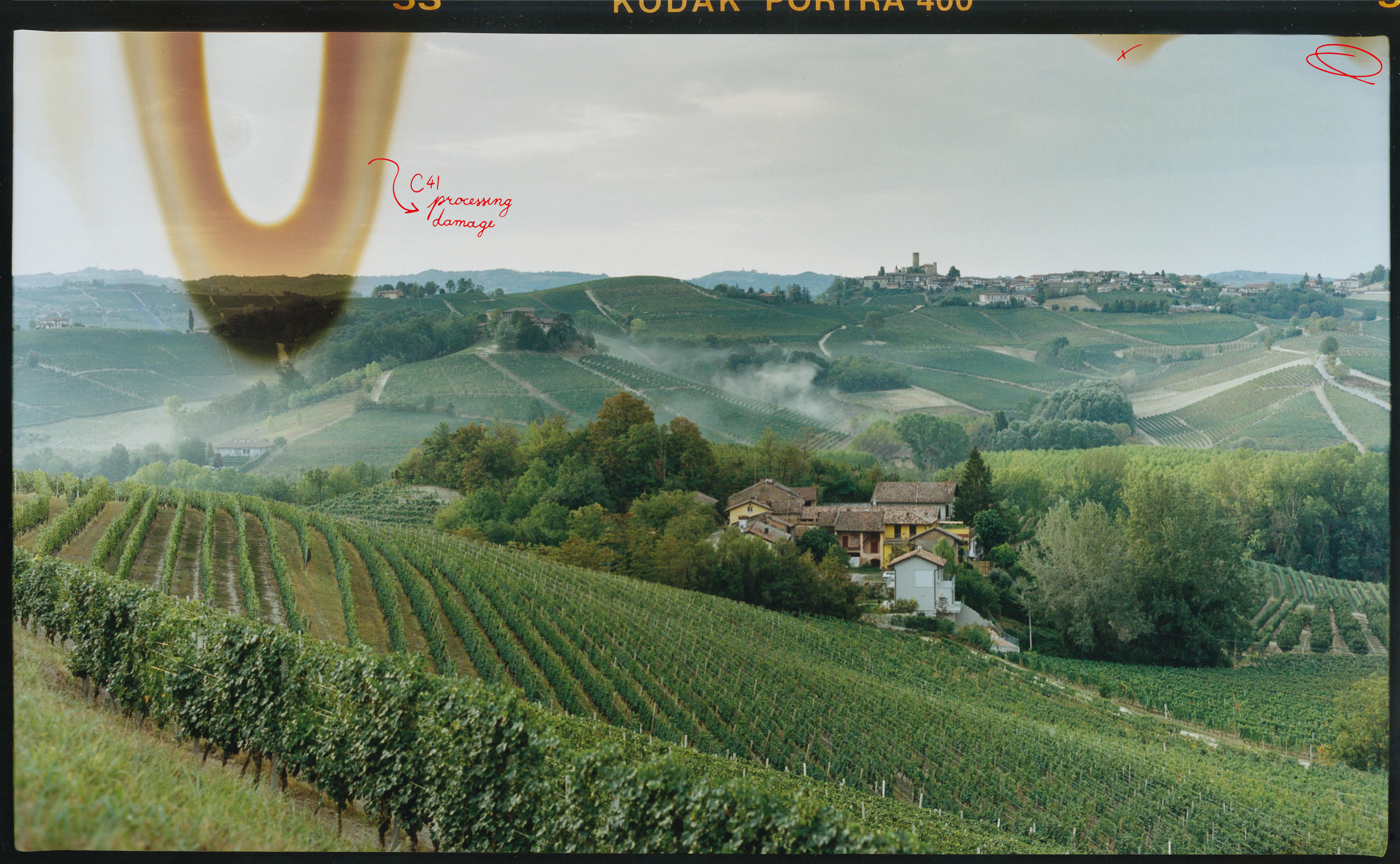
It’s the worst news a photographer could hope to hear. On that dreary September day, I collected my photos from the lab, taking them home and peeling open the envelope. Part of me held onto the hope that it wasn’t all that bad. But all the tentative excitement I’d felt while waiting for the rolls to be developed fully disappeared in that instant. As I flicked through the negatives, I felt a growing sense of disappointment. One roll of film was completely ruined, while others had damaged colours and chemical stains due to the accident during the development process. On the flight back from Piedmont in Northern Italy, I had let my mind wander, imagining the sort of shots that would emerge from the process. Sadly, these images were nothing like that.
Months later, I revisited them. I bought a film scanning kit and decided to see how much information they still held. As I edited them, memories came flooding back. It was two years ago when I travelled to Piedmont, with Italy Buyer Davy Żyw and photographer Jason Lowe, to capture the winemakers during the harvest. The scorching Italian sun intensified the sweet aroma of wine from barrels that filled the air. You could hear the machines separating the ripened grapes from the stems, mingling with the Italian chatter of the winemakers as they told us about their crops and the challenges they faced with the weather during the harvest.
As a photographer, I have taken many trips, and each one is incredibly demanding and exhausting. Your mind starts racing the moment you get into the car and head to a picturesque location before sunrise. From that moment on, you are in a constant state of passion and focus until the sun sets. You strive to find the right streams of light and intriguing shadows, to capture the tireless work of a harvest. In a sense, the work of a photographer reminds me of chasing sunbeams.
Using an analogue camera is a different process from what I’m accustomed to with digital projects, where you observe photos on the small screen of a digital camera, then on a computer screen, and finally on a phone screen. I love that in a fully digitalised world, I can immerse myself in the craft of photography in a more tangible form – from loading a new roll of film, setting the exposure, and pressing the shutter button; to handing it over to be developed in the lab, and finally printing the photos by hand in a darkroom. Just before releasing the shutter and exposing the film, my mind enters a meditative state. It’s a welcome change, where I’m insulated from external noise, with a sense of hearing akin to that during diving. I am focused solely on the moment when I expose the film, after which everything snaps back to full speed, and all the sounds intensify in a split second.
It was a pleasure to look at these photos again while writing this essay. They evoke fond memories of my time in Piedmont that September, each containing a snapshot of a story. Now, let me share the stories behind each of them.
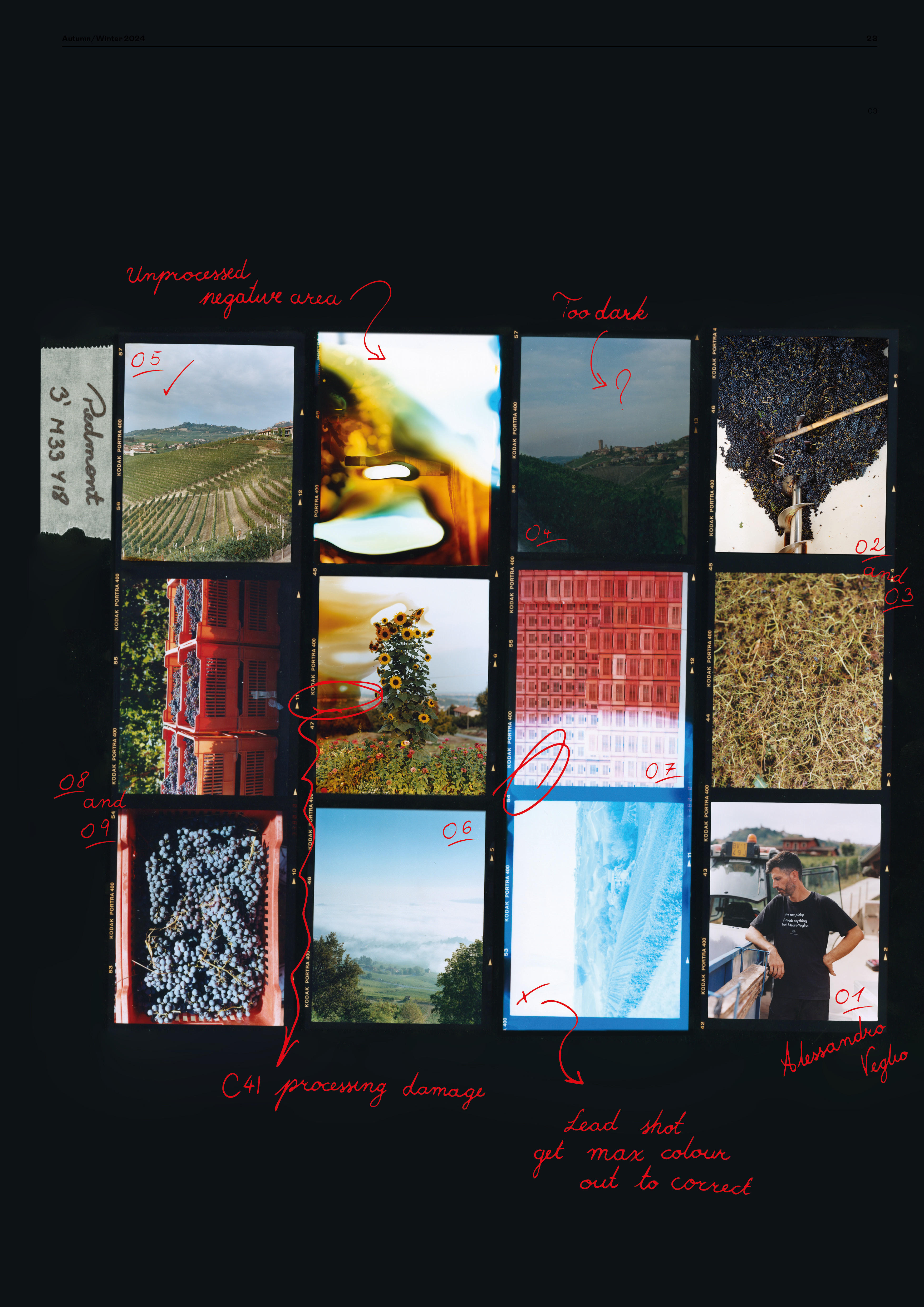
Alongside his digital camera, Krystian uses a Pentax 6x7 analogue camera. He shoots with Portra 400 film, renowned for its warmth and richness
01: Alessandro Veglio, winemaker at Mauro Veglio, Cascina Nuova, Barolo
On the very first day, I had the privilege of observing the work of winemaker Alessandro Veglio in person. After welcoming us and giving us a tour of his winery, he introduced us to a majestic landscape where picturesque hills were fully green, with ripened grapes waiting to be harvested. The machine separating the grapes was in full swing, the sound of it filling the air.
This is one of my favourite spontaneous photos, taken at the end of the shoot just before Jason Lowe and I were about to leave for the next producer. I noticed Alessandro, tired, watching the process, deep in thought. What I love about this shot is that, even with such a large analogue camera, I managed to go unnoticed for a moment and capture the winemaker in a genuine, contemplative moment – much as street photographers do.
02 and 03: processing grapes at Luigi Giordano, Barbaresco
I had never seen freshly harvested grapes processed by such a machine before. Winemaker Matteo Giordano, after harvest, arrived at his estate with a trailer full of grapes ready for processing and separation from the stems. It was a very intriguing and advanced process, which was much faster compared to others. I love the combination of the machine pulling in the grapes and the manual use of the rake in one shot. The appearance of the grapes, resembling caviar, and the deep, intense, purplish-blue colour of the grapes are captivating. After the grapes had gifted us with their rich colour, only bare stems remained. They were being thrown out manually with rakes by Matteo, from a cellar half a metre below ground.
04: village views, Barbaresco
A sweeping view of the village from Luigi Giordano's vineyards. At the end of the day, we set out to capture the stunning landscape surrounding the area after our visit. In front of me, I saw deep green vines in the foreground, partially revealing the town of Barbaresco, with the next set of hills visible in the background. Unfortunately, the photo came out too dark. Nevertheless, I still love the layered complexity of this shot, with the sun subtly lighting the town from the left side, giving the image a three-dimensional quality.
05: striking slopes La Morra, Barolo
This was taken on the morning of 14th September at around seven o' clock in the morning, as we set out to scout various interesting landscape locations. There's a complexity to the landscape in La Morra that makes it particularly striking for photography. The greenery of the vines colours the entire space. Shortly after this photo, we arrived at Marcarini, whose winery is based beneath the clocktower in La Morra’s village centre.
06: from a vantage point near Marcarini, La Morra, Barolo
This shot was captured at around 8am, as we were on our way to meet the winemaking team at Marcarini. This view is just outside the winery, where we could admire the workers labouring hard from early morning over a new delivery of freshly harvested grapes. The mystic fog in the photo unveils the rest of the buildings on the horizon as time passes. I love how the trees in the foreground frame the composition, allowing our gaze to take in the full landscape.
07: a wall of red crates Castiglione Falletto, Barolo
Nothing catches a photographer’s eye like a pattern. Where there is harmony, symmetry, and order, there is my attention. In such moments, I can already imagine the final photo hanging on a wall, adding character and interest to a room. These red crates speak more than a thousand words. They show me how much effort, hard work, and love for wine passes through the hands of workers in a single day. These crates were resting against a building wall in the town of Castiglione Falletto.
08 and 09: harvested grapes collected in crates at Roagna, Barolo and Barbaresco
On the last day, we ended by visiting the historic winemaker Roagna. While admiring the view of the hills full of green vines from the estate, I noticed a parked tractor with crates full of grapes. I went to take a closer look, and despite the lack of time, I had to capture this harmonious pattern and the three layers of colours: green, purple, and red. I love the shadows and contrasts at play in this image, and how the colours really sing.
In a world that’s increasingly digital and fast-paced, our attention has become a highly sought-after commodity. Amid this rush, analogue photography stands apart. It has a rawness and authenticity that comes from being limited to a handful of shots. You choose your moment carefully, forced to slow down. It stands in opposition to the endless choice of digital media, and this is what makes each shot so special.
The question of authenticity is paramount to the artist. We strive for a conscious and genuine approach to our craft, one that reflects our truest selves and our unique perspectives. We want our work to speak for itself – but for us too. This desire for authenticity isn’t limited to photography; it resonates with winemakers as well. Their final product, which we eventually get to taste, is an expression of their vision, opening itself up to both praise and critique. Both can make us feel vulnerable, yet they are essential for growth. In an era where we crave tangible experiences, the craftsmanship involved in creating something by hand offers a rare connection between the creator and the consumer.
Though the photos I poured my heart into were marred by an incident during development, this setback added character and depth to the story I now share with you. The painstaking process of hand-printing these images became another layer of craftsmanship, allowing me to invest my heart in them once again. What emerged was something even more meaningful than what I had initially envisioned – a testament to the idea that, as the painter Bob Ross famously said, “We don't make mistakes, we have happy accidents.”



