


Cotswolds Distillery: place, people and purpose
Written by

On a baking hot day in June, I visited Cotswolds Distillery with colleagues from our Spirits Shop. Founded in 2014 by New Yorker and ex-financier Daniel Szor, Cotswolds Distillery is his love letter to the county he now calls home. It has been part-owned by Berry Bros. & Rudd since 2023.
After passing through beautiful wrought-iron gates and driving up what seemed like a typical gravel driveway, I wasn’t expecting the scale of the sight which greeted us. A beautiful building of close-boarded wood and floor-to-ceiling glass windows, it was, at once, breathtakingly modern and expectedly Cotswoldian. Housing a beautiful gift shop and a bustling café, it’s little wonder this is now the Cotswolds’ third most popular visitor attraction – the first two being Gloucester Cathedral and Adam Henson’s Cotswold Farm Park.
Our hosts for the day were the distillery’s Whisky Brand Ambassador, Rob Patchett, and tour guide, John Darbyshire. “We’re doubling our whisky production this year”, Rob boldly declared, “to about 200,000 litres.” This is the target of the distillery’s Head of Production, Alice Pearson. Not even 30, Alice started her career in the shop at Cotswolds Distillery, before taking on tours and her current role, after a few short years.
Production and Cotswolds terroir
Daniel Szor was a guest on series four of our podcast, Drinking Well with Berry Bros. & Rudd. Then, he spoke with passion about his desire to create Cotswolds spirits with “expression of terroir” and “a sense of place, of a philosophy.” The starting point for this is the distillery’s barley – all grown and farmed locally on the Blenheim Estate.
Cotswolds Distillery has sourced barley from the same farmers, Michael and Philip Green, since 2017. The Greens’ farm has been in their family since 1878. For the agri-geeks among you, the barley variety used by Cotswolds Distillery is Laureate – a high-yielding variety with strong disease resistance. They use Plumage Archer, a heritage variety developed at Warminster Maltings in 1905, for the distillery’s Highgrove bottlings. “Our barley all goes to Warminster”, Rob told us. “It’s Britain’s oldest operating maltings.” Once the fermentation and distillation are complete, further in the process, a local farmer takes all the spent mash for his dairy cows, two miles up the road from the distillery – and so the cycle of sustainability goes on.
The winning gin recipe
Heading into the gin distillery, Rob introduced us to two very special ladies. “The wash still is called Proud Mary and the spirit still is called Janis [Joplin]”. Daniel’s apparent love for his home nation’s music scene wasn’t lost on any of us.
Gin production here was first carried out in a Holstein still – called Lorelei – in 2015. The following year, Cotswolds Distillery’s gin was named “Best London Dry Gin” at the World Gin Awards. Surfing the wave of success, the distillery needed to increase its production so shortly afterwards, another bigger still was bought. Her name is Dolly – what a way to make a living.
“Our gin is actually based on your No.3 Gin,” Rob told us. We all grinned excitedly, eager to know more. “We had a tasting of about 200 gins, blind. Dan tasted the No.3 Gin and said ‘I want that but amplified’ and that’s what we did.”
It is made with nine botanicals including Cotswolds lavender from Snowshill, citrus peel, spices and bay leaves. The unusually high number of botanicals means this wheat-based spirit takes on a subtle pearlescent hue when ice or tonic water is added as the botanicals release their oils. The heads and tails from the gin’s production – the first and last fractions of a full distillation process – are removed and go into biofuel.
To whisky and beyond
Away from its award-winning gin, the distillery is renowned for whiskies which express that Cotswolds barley character. These include the Classics Collection and some limited-edition special cask bottlings.
The Signature Single Malt is the first whisky ever made in the Cotswolds. It is partly matured in STR (shaved, toasted and re-charred) ex-red wine barriques. The shaving removes some of the red-wine residue, toasting adds sweetness (like caramelisation) and the charring adds a layer of charcoal for filtration and the release of flavours. This flagship whisky is refreshingly fruity with treacle, warm spice and a moreish finish. It is blended with whisky from first fill ex-Bourbon casks which adds a baking-spice lift and creamy texture.
As we headed up to the tasting room, a shelving unit packed to the gunnels with many of the distillery’s bottlings – past and present – greeted us at the top of the stairs. “We’ve done some really mad experiments and limited runs over the years”, Rob said. These include a Cotswold Calvados (delightfully mooted as “Cotswold-ados”), a variation on Vin Jaune and a 2023 rum – made with Tate & Lyle treacle. They even employed the advisory services of legendary Vivian Wisdom from Hampden Estate in Jamaica. The ever-popular Cream Liqueur is well-worthy of a mention here too.
The tasting highlight for all of us on the day was the Hearts and Crafts Calvados Single Malt Whisky (55%). Celebrating the Arts & Crafts Movement of the late 19th century, each bottling from this series is sold in a beautiful presentation box, covered in a William Morris print. The nose is extraordinary, with rich apple and crème brûlée leaping out. The palate is pleasantly prickly with hints of dried apple and subtle rose. A few drops of water made everything pleasingly candied, reminiscent of childhood.
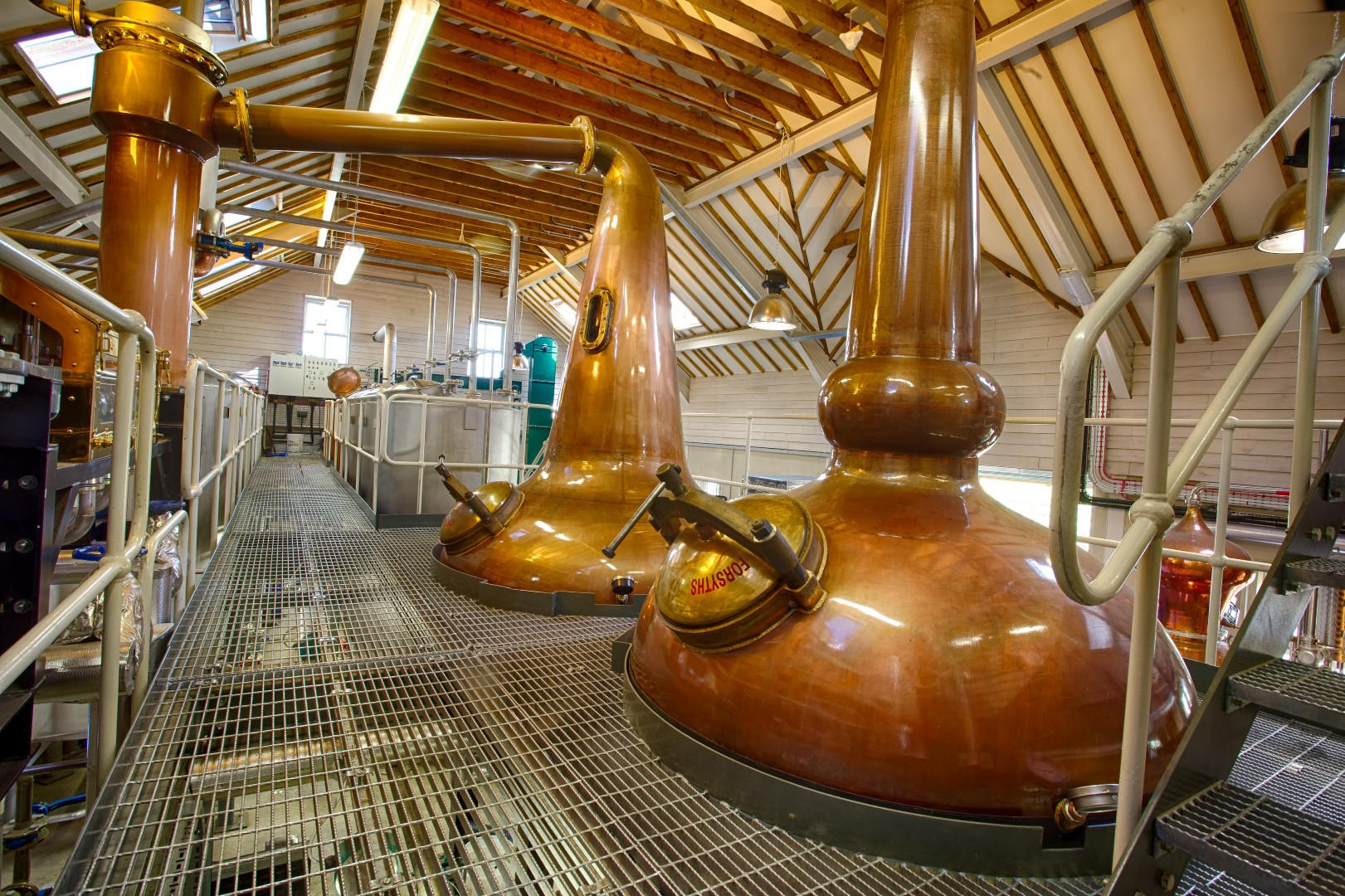
Pot stills at Cotswolds Distillery
Bottling (community) spirit
The bottling of these delicious liquids is done on-site by just three people – all locals. They aim to process 1,440 bottles per day. Judging by the efficiency on show during our visit, I have no doubt they regularly achieve this.
There is a real sense of community spirit here. There are young people here for whom this is their first job and there are people who have been here since the distillery’s founding. Daniel Szor had always said that his desire was to give something back to his adopted home county.
Wetlands
Berry Bros. & Rudd’s investment in Cotswolds Distillery facilitated the development of the distillery’s wetlands site. In August 2024, it was officially opened. As part of the plan to tighten up the sustainability of the distilling process, these wetlands provide a solution for the wastewater here.
Technically a “wetlands ecological treatment system”, this beautiful area of wildflowers and plants processes three-quarters of Cotswolds Distillery’s wastewater. Specific plants, grasses and trees were selected for their natural ability to degrade contaminant chemical compounds in the waste. The resulting clean water is utilised in growing willow trees.
“The wetlands provide habitat for wildlife, increase biodiversity and reduce tankers and traffic to and from the distillery” Rob explained. “The wetlands are scalable, so they can grow with us and our production.”
Where there are wildflowers, there are usually bees; Cotswolds Distillery is no exception. Honey made from local bees is sold in the distillery shop and used to make scented candles.
No visit to a distillery, specifically one which makes whisky, is complete without a pilgrimage to its warehouse. These cool, peaceful spaces are where whiskies are left to quietly mature in their allocated barrels. In this particular warehouse, just under half the barrels are red wine STR casks, 30% first-fill Basil Hayden Bourbon, 10% ex-Laphroaig, 10% Miguel Martin Sherry and 10% other casks – including some 90-year-old Calvados puncheons and rum casks. Just as the distillery experiments with its liquids, the scope for experimentation with these maturation vessels is also vast.
Whether it’s with gin, whisky, a cream liqueur or something more experimental, Cotswolds Distillery has carved its own niche in the world of terroir-driven spirits – while minimising the impact of that niche on the environment. With a clear flair for experimentation and some surprises already quietly maturing in that special warehouse, the spirit of the Cotswolds is future proofed.



