

Rediscovering Chambolle-Musigny
Written by

During my time in Burgundy this year, tasting the 2024 vintage, I was especially impressed by the quality of the wines from Chambolle-Musigny. The character of the commune seemed to be very successfully framed by the style of the vintage, being focused on purity of fruit and delicacy of expression. There seemed to be a splendid alliance between the personalities of both elements.
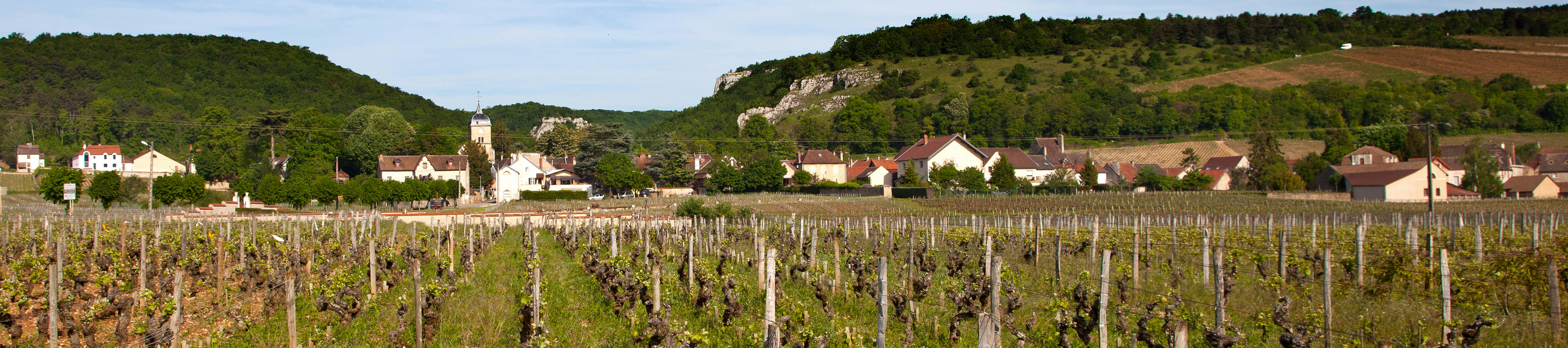
The wines of Chambolle-Musigny are renowned for their fragrance and sensual textures, although recent hot vintages have begun to challenge that expression. With 180 hectares of vineyards, this is one of the smaller communes of the Côte d’Or. The village itself sits with Morey-St Denis to the north, while its most southern vineyards abut the Grand Cru of Echezeaux in Vosne-Romanée. Chambolle has a higher level of active limestone (rock still in the process of decomposing) than either neighbour, so the wines are paler in colour and more aromatically focused. In addition, the small but impressively steep-sided gorge, the Combe de Chambolle, sits at the top of the village. This and the Combe d’Orveau, at the south of the commune, both trap and disperse cooler air across the vines.
The village itself is small, with no signs (yet) of developing a serious tourist infrastructure. There are no trendy new wine bars as in Vosne-Romanée, just a couple of simple restaurants. In fact there are only about 20 producers with their wineries in the village. The most famous are Comte de Vogüé, Frédéric Mugnier at Château de Chambolle-Musigny, Georges Roumier and Ghislaine Barthod. Several renowned domaines from other communes also own land here, including Jean Grivot, Sylvain Cathiard and Michèle et Patrice Rion.
Musigny, Bonnes-Mares and friends
In common with most of its Côte de Nuits neighbours, the village adopted the name of its most famous vineyard, thus becoming Chambolle-Musigny in 1882. The Musigny vineyard is indeed the jewel of the commune and, arguably, the entire Côte d’Or – challenged only by Le Chambertin and the greatest sites of Vosne-Romanée. Lying at the southern end of the commune, it is defined by its extraordinary ability to combine haunting, visceral perfumes with subtle yet exponentially intense textures. Truly, there is not a wine comparable to it in Burgundy. The vast majority of its ownership lies with the producers based in the village, with De Vogüé having almost two-thirds of its nearly 11 hectares. This includes a small parcel of Chardonnay which, since 2015, has again been producing Musigny Blanc (having produced a Bourgogne Blanc since the vines were replanted in 1993).
The commune’s other Grand Cru is Bonnes-Mares, at the opposite end of the village. In fact, a small part of the vineyard lies in Morey-St Denis; overall Bonnes-Mares seems to produce a wine that is bigger-boned and richer than archetypal Chambolle. The vineyard’s geology is complex and there are two distinct soil types, both red (lower slope) and white (upper) marl that produce identifiably different wines. The vineyard’s proximity to Morey – it adjoins Clos de Tart at the northern boundary – means there is more than a passing similarity to the wines of that commune.
Both Grands Crus have superior Premier Cru siblings that approach Grand Cru in quality: Les Amoureuses lies just below Musigny; and Les Fuées is a continuation of Bonnes-Mares. Both are small, each less than five hectares, with the wines hard to find.
The joy and pleasure of Chambolle-Musigny
But for most, the joy and pleasure in Chambolle comes from the myriad of other Premier Cru and village-level vineyards that make up the heart of the commune. Other Premiers Crus worth seeking out are Combe d’Orveau (there is also a village vineyard of the same name), Baudes, Charmes and Cras. The latter also has sections in both Premier Cru and village; climate change has warmed this high hillside site to the point where very interesting wines are now made. Many village blends can include some Premier Cru fruit from a parcel that is too small to be made as a standalone wine, but some individual sites are worth looking out for.
There is no better way to appreciate the essence of Chambolle than to taste in the cellars of Ghislaine Barthod. Today, the wines are made by Ghislaine’s son Clément Boillot. Here, wines from up to 11 different single vineyards can be tasted side-by-side and the nuances of the commune illuminated. To the north, the wines tend to be more tannic and structured. To the south, the textures are silkier and more perfumed. The wines at higher altitudes are dynamic and direct, those from lower ground more rounded and plumper. The benchmark Barthod village Chambolle is a blend of 11 parcels from all around the village, plus any young vines from the Premiers Crus. The only sadness is that the estate has no Grand Cru vineyards.
For many, Chambolle is the essence of red Burgundy, epitomising why people fall in love with Pinot Noir. It speaks of a certain style, of a beguiling intangibility and delicacy, and yet is capable also of profundity. It is not about the power of Gevrey, the vitality of Morey, the regal pomp of Vosne or the muscularity of Nuits-St Georges. Its cousin in the Côte de Beaune would be Volnay, another wine renowned for its remarkable perfumes. But Chambolle at its best is even more alluring. Yet this is an expression that has been slipping out of reach during the recent run of warmer vintages. Some of Chambolle’s earlier-ripening sites have produced wines that, while still giving pleasure, have an atypical richness. So when the opportunity arises to experience Chambolle at its most irresistible, as in 2024, seize it.



