

Discovering Anjou Noir
Written by

The Loire valley is, undoubtedly, one of the most dynamic and exciting wine regions in the world. Each time I visit, I come back invigorated by the enthusiasm and energy of its vignerons and armed with a list of potential new suppliers. Among the many exciting sub-regions of the Loire, one that stands out for its potential to produce truly great wines is the region known as Anjou Noir – the western half of the Anjou region.
Confusingly, the “Noir” in the name refers not to the colour of the wines – the best wines are in fact white (and dry) – but to the colour of the soil. The Anjou region can be broadly divided in two across an east-west axis through the city of Angers. The soils to the east of Angers and around Saumur are light-coloured limestone. This region can be referred to as the Anjou Blanc region. In contrast, the Anjou Noir has darker schist soils. A simple visual demonstration of the difference can be seen in the contrasting construction materials of Château d’Angers; a mix of dark grey schist and white tuffeau.
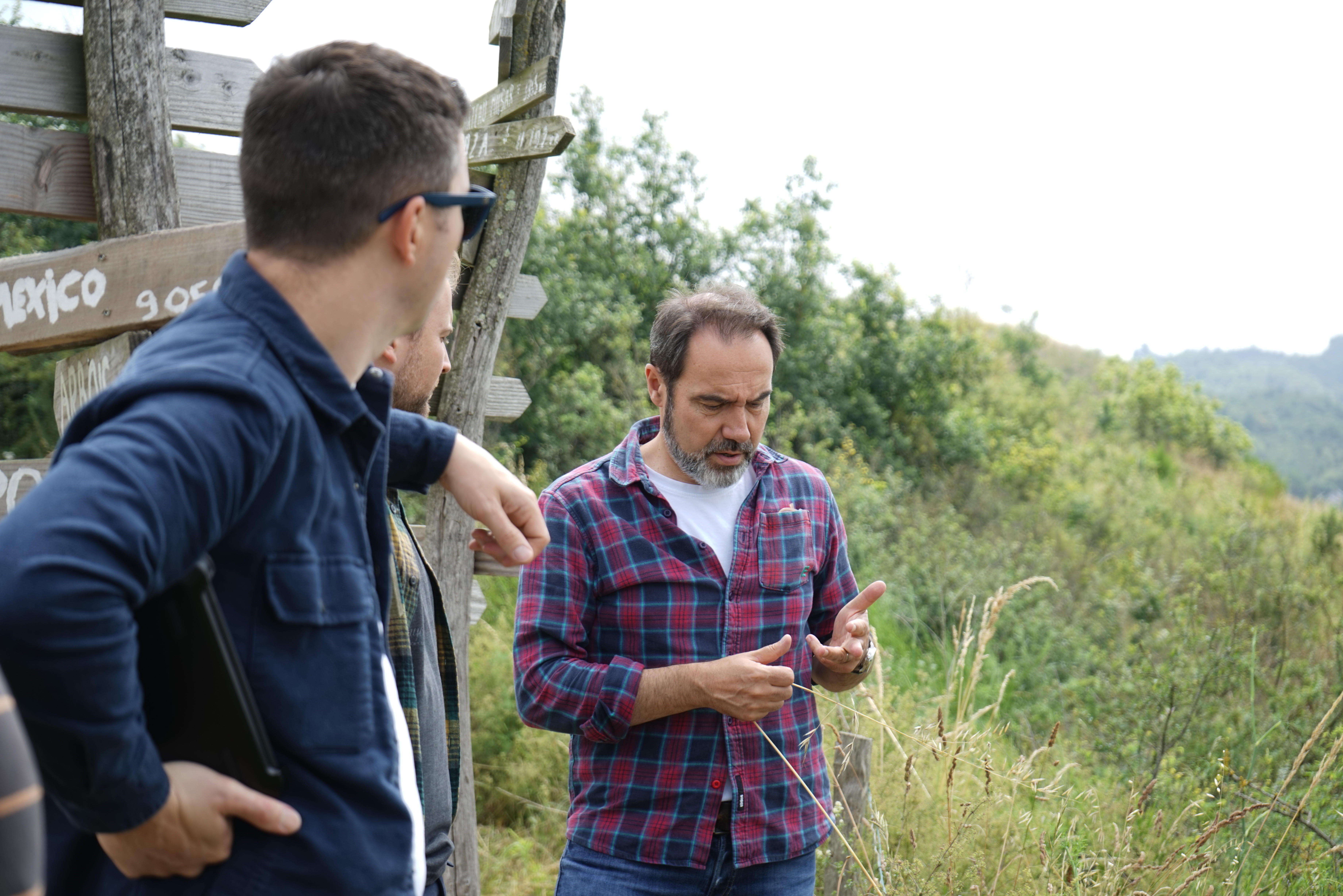
01: Buyers Adam Bruntlett and Yoan Bernard with Ivan Massonnat of Domaine Belargus
The distinction is due to a geological fault which separates the two regions: with the youthful, sedimentary limestone of the Bassin Parisien to the east and the 400-million-year-old Massif Armoricain to the west. The schist soils have very little clay and absorb the heat of the sun, restricting yields and resulting in concentrated fruit. Typically, the wines of the Anjou Noir are therefore more powerful, spicy and “warmer” in feel than the cooler, more linear expressions further east.
Ivan Massonnat, owner of Domaine Belargus, often describes the area as one of “geological chaos”. While schist is the catch-all name for the local soil, there is in fact a huge variety of different soil types: slate, gneiss, granite, spilite, quartz and many more. This diversity of soils leads to a diversity of wine styles.

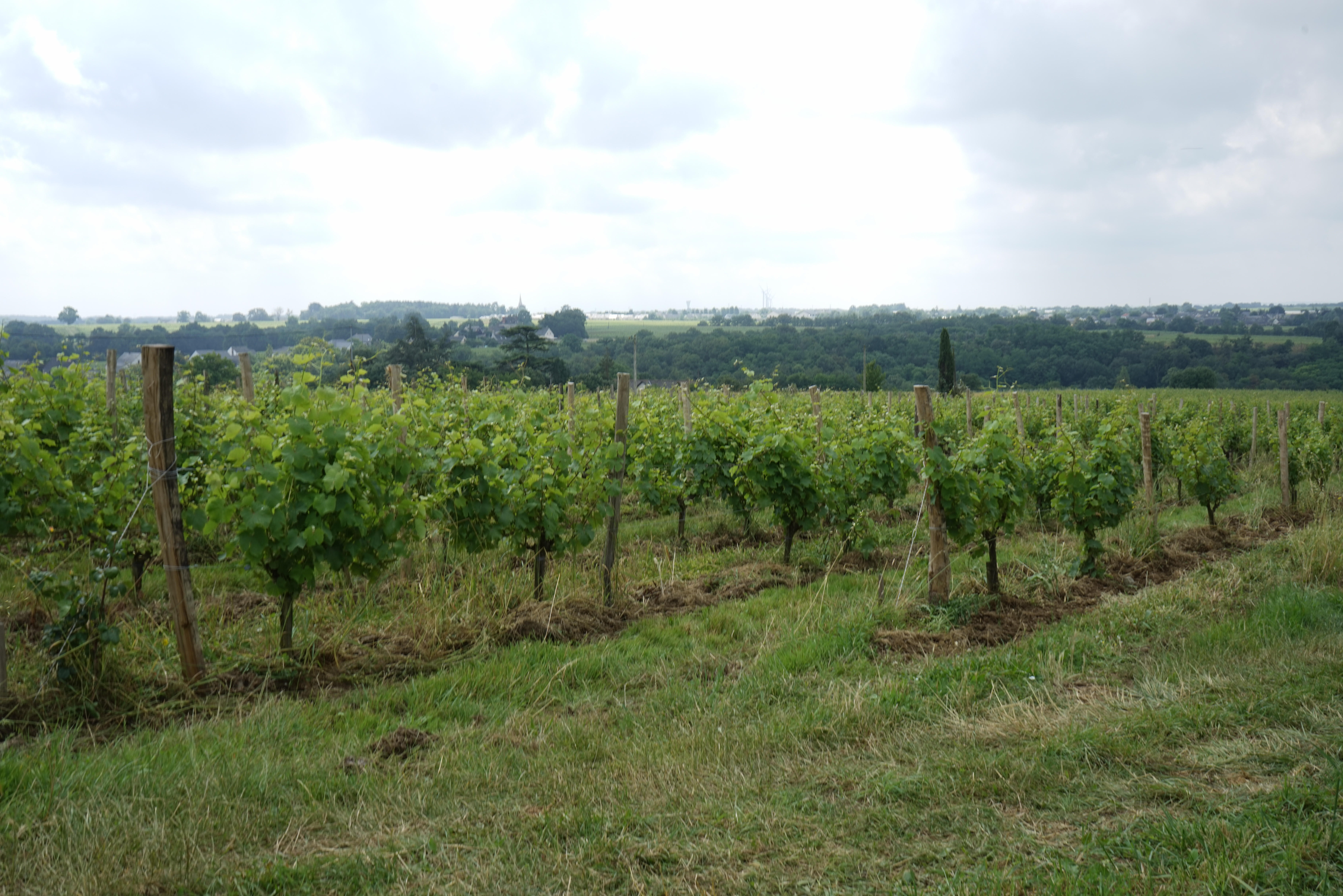
02: Vines and soil at Domaine Belargus
Another factor that defines the style of wines from the Anjou Noir is the climate, which is interestingly warmer and more windy than the Anjou Blanc. This gives a wilder, almost Mediterranean feel to the region. Indeed, the local flora and fauna can often be more typical of the south of France.
This part of the Anjou, like many areas of the Loire, has suffered from stagnant pricing and a lack of ambition. For many years, it was best known for Rosé d’Anjou, a commercial invention that emerged around the same time and with the same aims of Beaujolais Nouveau. This low-quality, medium-dry rosé was, unsurprisingly, not the region’s greatest advertisement.
While interest for dry wines in the region is only really picking up now, winemaking here is not new. Historically, some of the finest sweet wines in the world were made here, thanks to the autumn fog which enabled the regular production of botrytised grapes. Many wine enthusiasts will be familiar with the famous wines of Bonnezeaux, Coteaux du Layon and the Grand Cru of Quarts de Chaume.
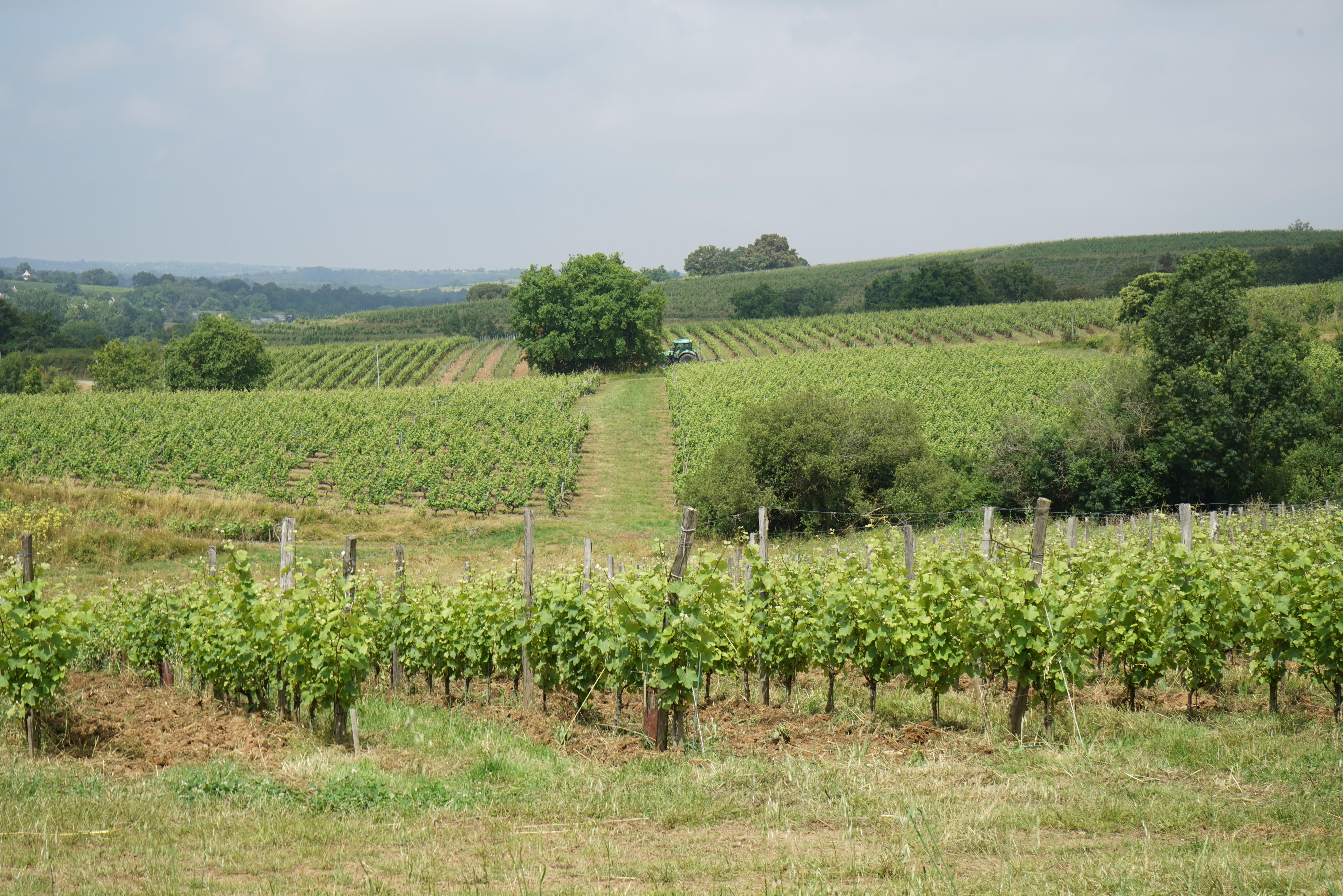
03: Landscape at Domaine Belargus
However, demand for sweet wine fell in the post-war period, coinciding with mechanisation and the use of chemical fertilisers and machine harvesting. The steep and difficult-to-work slopes of the most interesting vineyards were abandoned in favour of the easier plains. Chenin Blanc began to be replaced by Chardonnay and Cabernet Sauvignon. Chaptalisation (the addition of sugar to the grapes for fermentation) became the norm and production switched to sparkling wine and the off-dry rosé wine, Cabernet d’Anjou.
While a small band of quality-focused producers pushed back against industrial wines, notably in Savennières and Coteaux du Layon, still-wine production was in crisis. Fortunately, this small band began to grow in the 1990s, promoting organic viticulture and rejecting the methods of the post-war period. The focus switched to dry wines, but while the quality was evident, the market was not yet ready and it was, commercially, incredibly difficult to make a living from such wines.
This malaise was something of a double-edged sword. The commercial challenge of farming the low-yielding and precipitous hillsides meant top sites could be picked up for a song by those with ambition, commercial nous and a fresh perspective. Enter the likes of Ivan Massonnat and Terra Vita Vinum’s Benedicte Petit and Luc Briand. Along with others, they saw the potential of the region and quickly set about pushing the bar higher, with the aim of producing some of the finest dry white wines in the world.

04: Adam walking in vines at Terra Vita Vinum
But the story of Anjou Noir is not just about the wines. There is a much bigger picture to see here. Because of the relative nonchalance towards wines in the region, unlike Burgundy, Bordeaux or even Sancerre, vineyards do not dominate the landscape. Instead, there is a real patchwork of different land uses, with plenty of forest and scrub between fields and vineyards. Furthermore, because land prices remain relatively low, there is limited pressure to plant every last inch, even when newcomers arrive in the region to make wine.
Everyone we visited on our recent trip had set aside substantial parts of their land to encourage biodiversity. This was perhaps best demonstrated at Terra Vita Vinum. In each of the plots there, they have planted trees, shrubs and hedges, leaving substantial fallow borders for wildlife. One quarter of their land is not planted and will be kept as such to promote biodiversity.
There is an understanding that encouraging biodiversity will allow the vines to thrive as part of an ecosystem, rather than fighting against it like the previous generation. Rather than being seen as threats, the local flora and fauna are harnessed to help the vine to grow. Ivan Massonnat at Belargus shares the same vision, employing a full-time botanist and setting aside 10 hectares for biodiversity.
Coming away from the region, I cannot help but be energised and invigorated. The people are energetic and ambitious, with a passion for the environment and nature that goes hand-in-hand with their desire to produce some truly breathtaking wines. It is also reassuring to know that in supporting the wines, we are directly improving biodiversity as well as bringing lost vineyards back into production.



