High-tech wines
Written by
The essential equation of winemaking hasn’t changed for thousands of years: grapes plus yeast equals alcohol plus carbon dioxide. But this is an industry where evolution is constant. While some of this change is simply for innovation’s sake, many of the new technologies being developed or used today are designed with a specific problem in mind, whether that is reducing the effects of climate change, or combatting pests and diseases.
Other technology is allowing producers a far greater understanding of their vines and vineyards than ever before – helping them to create the best quality wine from the best fruit they can. Here, we consider the latest technology used throughout the wine production chain.
Technology in the vineyard
Randall Grahm is on a mission to create 10,000 new grape varieties, which are suited to the increasingly hot, dry climate of California. At first glance, this might not seem like a bold application of technology to create the future of wine, but it most certainly is. Bringing together literally millennia of understanding of how vines have adapted to their environments, combined with the most recent research on vine genetics, Grahm hopes to achieve something that no one has ever done before – create truly new grape varieties, perfectly tailored to a place.
And that place, California, is not necessarily the most hospitable location. Currently Grahm is researching whether he can cross ancient vine varieties together, to create grapes which have natural resistance to Pierce’s disease. This bacterial infection is a potent threat in California, attacking vines and killing them within a few years. So far, research and all known pesticides have failed to provide a lasting solution to the threat of Pierce’s disease, which has also devastated olive groves in Puglia.
Once vines are planted though, be they new varieties or old, technology has multiple uses in the vineyard. Drones, in particular it turns out, are not just great for capturing stunning holiday snaps, but have shown real utility hovering above the vines. They can quickly fly over a vineyard and take detailed photographs, which can highlight any areas of damage or vines that are failing to thrive due to insufficient nutrients. Drones can even be used to assess how reflective a vine’s leaves are, which is a direct indicator of water stress – those vines in water deficit tend to have duller leaves. In an area such as California, where only recently Central Valley growers were banned from sourcing water from the San Joaquin River Delta due to extreme drought conditions, any method for using only as much water as is needed, and no more, is vital, and increasingly necessary.
Preventing pests
The power of drones does not stop at irrigation management. So versatile is this technology, that drone photography can be used to identify blocks of vines which are infected with viruses such as leafroll or red blotch. Both of these cause characteristic patterns on a vine’s leaves, and can spread quickly through a vineyard, devastating the plants. Rapid removal of the infected vines is crucial, and such technology can assist with this, saving growers many thousands of pounds in remedial or replanting costs.
They can also assist with pest prevention. One of the biggest threats to grapes is not in fact fungus, or bacteria, but birds, which every year eat thousands of tonnes of healthy grapes in vineyards around the world, leaving even more damaged and open to disease. In Argentina, however, drone use for bird scaring has been very successful, and Bodega Catena Zapata, in Mendoza, has eliminated all crop losses from birds since using the technology.
What is gradually becoming evident though is that the most effective uses of technology are not just those that layer cool gadgets on top of the work that farmers do, but those that provide insights into how to help the vines and vineyards defend themselves.
Take for example Genodix. This is a new technology being trialled in Burgundy by Domaine Henri Rebourseau. Genodix emits soundwaves into the vineyards thrice daily to help harden the wood of the vine trunks. This is proving effective at warding off trunk diseases like esca – diseases which, once they infect the vine, cannot be removed, and in some parts of France are killing up to 10% of vines in a vineyard every year. So far, Rebourseau are delighted by the results, and are seeing a reduction in powdery mildew rates as well. They will be continuing the trial.

Similar long-term studies and insights have led to the conclusion that bat colonies could well be as effective as traditional chemicals at combatting grey rot. Known as botrytis when it is making delicious sweet wines, grey rot is, for dry white and red wines, a hugely damaging vineyard fungus, its spread accelerated by pests such as the European grapevine moth. As producers in Bordeaux, for example, gradually turn away from traditional fungicides, technology that readily demonstrates the benefit of such natural predators is a huge boon. The local wine board, the CIVB, has even set up an app for those properties wishing to take part in the study.
Combatting climate change in the winery
It is perhaps in the winery where technology can have the most visible impact on wines. Once winemaking involved bringing in ripe, healthy grapes, and occasionally adding selected yeasts to kickstart the fermentation, before ageing the finished product in oak barrels. Today though there are increasingly complex machines and processes to eliminate problems with grapes or the finished wine.
The most widely used is reverse osmosis or, closely related, spinning cone technology. In both, the technology separates out the components of the wine – alcohol from water and flavours. You can then choose to remove an element of the alcohol, and blend the remaining components back together to create a lower-alcohol wine.
As alcohol levels increase due to warmer summers and riper grapes, this technology is being seen more and more. In theory, by only removing a small portion of the alcohol, the overall taste and character of the wine should not be affected. In practice, alcohol has a powerful impact on a wine – adding body and texture, a perception of sweetness, and helping to lift flavours and aromas. Adjusting the alcohol by just two degrees can have a remarkable impact on the wine, and some producers argue that it is too dramatic an intervention to be used on quality wines. Nevertheless, in a world where grapes are consistently overripe, it is one more useful tool that producers have in their kitbag.
Alcohol reduction may be seen as a luxury by some winemakers, but removal of smoke taint is sadly becoming more of a necessity. With increasing incidence of wildfires in regions such as Northern California, Australia’s Adelaide Hills and South Africa’s Stellenbosch, more and more grapes are being harvested with smoke taint. This can result in a wine that tastes bitter and acrid. For many producers, their only option is to treat the wine to remove these flavour compounds. Spinning cone technology can help to separate out the offending flavour compounds. While the final wine will never be as delicious as one unaffected by smoke, again this is useful – sometimes vital – technology for producers in areas at high risk of forest fires.
The future of wine security
Time was that wine producers couldn’t be trusted to make unadulterated wine. In fact, wine merchants like ourselves worked to get our hands on barrels as soon as possible, and aged wines in their own cellars, to reduce the risk of the wine being tampered with in the country of origin.
Provenance, and quality, of the wine in the bottle is as much an issue today as it was 200 years ago, but the tools of protection have certainly evolved from early shipping, and large leather-bound sales ledgers.
Some bottles are now fitted with RFID tags. These radio frequency devices can show exactly where a wine has been. They can even highlight whether a case has been exposed to high temperatures during transit which may have affected the quality of the wine.
Many Champagne Houses such as Krug prefer QR codes on every bottle – these machine-readable labels allow consumers to scan and see further details on their bottle, verify its authenticity, and, in addition, review food and wine matching options.

The most advanced tracing technology for wines today though is based on digital ledger technology such as blockchain. Jeffrey Grosset, maker of precise, dry Rieslings in the Clare Valley in Australia, has collaborated on one such wine-specific security system called Entrust, which uses blockchain technology to verify every stage of the production, shipping and sale process of his wines.
As blockchain and the like gain momentum as alternative security mechanisms, we are likely to see more producers and importers offering this as a means of guaranteeing wine provenance. It also helps customers understand more about the wine production chain, where their wine has been and for how long.
However, the technology is not without its detractors. The large carbon footprint required to run the transactions means it will be unlikely to be rolled out on a huge scale. Nevertheless, it is cheering to see such continued innovative approaches to the age-old issue of counterfeit wines.
A solution to serving?
The service of wine was changed forever a decade ago with the creation of the Coravin system. Up until this point, bottles had to be opened in their entirety if one wished to taste the contents – and while wine preservation systems did exist, they would only protect the opened bottle for a few days or a week at best. With the invention of the needle and argon gas system, it is now possible to pour a single glass of a fine wine, and leave the remainder in the bottle, protected, to be enjoyed in months or years ahead.
As a solution to reduce alcohol intake, this is far more elegant than any number of spinning cones or reverse osmosis machines and allows oenophiles and collectors to savour their collections in an entirely different way. Since 2011, other products with a similar aim have come onto the market, each more automated than the last.
Naturally, this creates an entirely new problem of storing and cataloguing one’s wines, to ensure that the perfect bottle is not brought out for dinner, only to discover that it has but one glass remaining of it. Helpfully though, there is an app for that – in fact a profusion of them – that promise careful cellar management and access to details about your wines on the go.
And if you should choose to open up that special bottle, but aren’t sure about how long it should be decanted for, there is a solution for that too. The iSommelier is an automated decanter that gently bubbles oxygen throughout your wine, speeding up the decanting process. It’s ideal for when you want to serve a full-bodied red to unexpected guests. It certainly receives high marks for convenience, though some would argue part of the charm of wine is watching it evolve over the course of the evening, in your glass.
The end of the vineyard
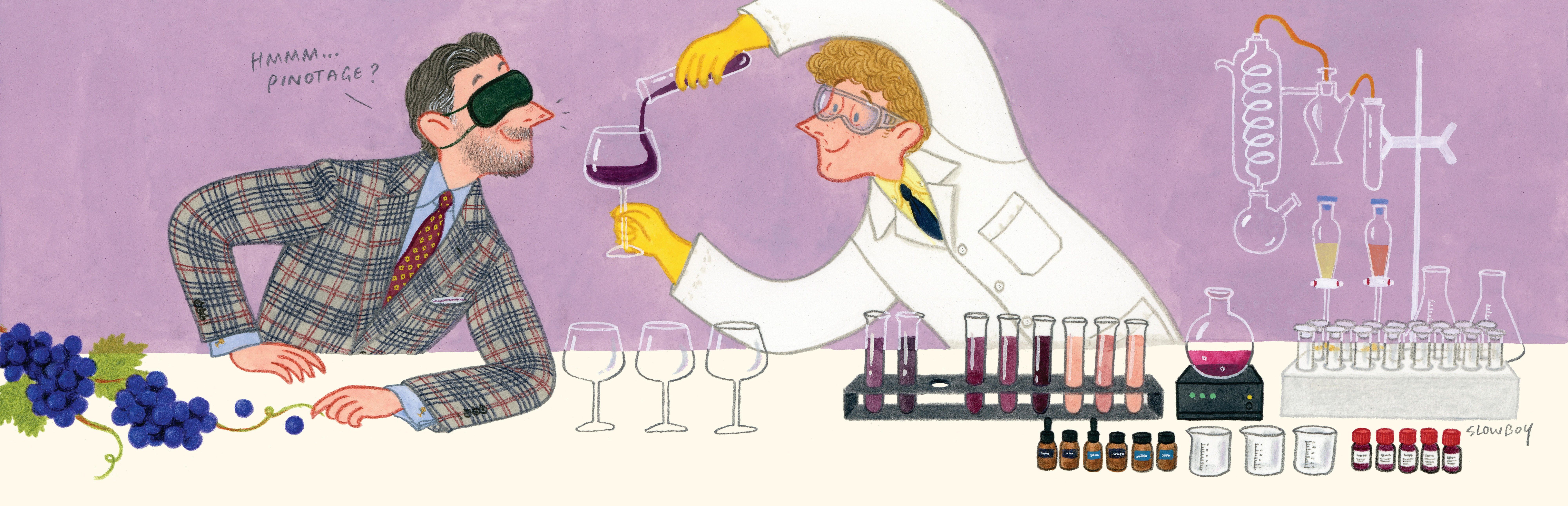
Stepping away from the world of now into the future for a moment, what if wine in 10 years’ time had nothing whatsoever to do with grapes? What if the future of wine was 100% lab-based?
This is not just in the realm of science fiction – there are now a handful of companies making this a reality, and synthesising iconic wines in a laboratory. By taking a grape-based wine and analysing its chemical structure, they can build an exact replica, one which is almost impossible to identify as a copy in blind taste tests.
The question remains though: if two wines are chemically identical, and cannot be distinguished in a blind tasting, then does it matter that one was created in a lab and not in the vineyard? As we can see, technology now touches all areas of grape-growing and winemaking, not to mention shipping, storage and serving. The argument that wine is (or should be) a natural product, with no human intervention at all, feels increasingly difficult to make.
Synthetic wine could provide the opportunity for a far wider range of consumers to taste mature or iconic wines – currently out of reach due to scarcity and price. They could even allow for greater training for those in the wine industry, or working against wine fraud. Being able to taste a perfect example of a 50-year-old wine, to see what it should taste like, can help sommeliers identify issues with older bottles they are opening. Under that umbrella, synthetic wine certainly has a very valid place in the world of wine.
But will it ever be enjoyed for its own sake? A similar debate is currently ongoing in the world of jewellery, with lab-created diamonds being pitted against mined diamonds, with all their myriad pros and cons. As with the wines, the chemical structure of these is identical, and they are almost impossible to tell apart, even to the trained eye. Both shine equally bright. And yet some consumers would argue that lab-grown diamonds are simply less appealing. Others would actively seek them out for ethical, pricing or traceability issues.
Ultimately, I believe a slow shift in mindset will occur and synthetic wines will become seen as just another facet of the world of wine. Just as screwcaps were seen as a sign of an inferior product when they were first introduced onto the market, many of us are now more than happy to enjoy wine bottled under screwcap. Some disagree, and stick firmly to cork. In the broad world of wine, replete with innovation, imagination and new technology, there is plenty of room for both views.