


Piecing it together: Mas de Daumas Gassac
Written by
It starts with the lagoon, and blue, blue water. Curtains of shellfish; oysters, mussels, hanging on threads, draped into the shallows rows at a time. They’re hoisted out a few times a week, to replicate the back and forth of tides, leaving them exposed for a few hours, helping to build texture. Small sea creatures have thrived in this part of the world for millennia, as we’ll see later.
We drive up to the domaine, or more correctly, the mas (mas being the local style of stone farmhouse in Languedoc-Roussillon) and when we stop, I’m confused. The winery sits on the very edge of the vineyard. Yet there are no fields of vines, no gently undulating vistas with rows of carefully trained plants and wires to support them. Instead there is forest; brush; scrub. There’s a handful of open areas which have been aggressively colonised by wildflowers.
This is Mas de Daumas Gassac; the property, the buildings. “Vineyards” would honestly be a stretch. We drive around the perimeter and across the land. I keep expecting to finally arrive, but no. This is it. Miles of forest interspersed with tiny pockets of vines. The largest contiguous area of vines is 2.5 hectares. In total there are 50 hectares of vines here; there are 4,000 hectares of forest.
The patch of wildflowers we’d passed was once part of the original vineyard, planted in 1972 with Cabernet Sauvignon vines. Still making up a key part of the blend every year, this old majestic vineyard needs constant maintenance and renewal. Replanting the entire vineyard in one go is not an option and would result in a huge change to the wine, losing all the 50-year-old vines at once. Instead the vineyard is being replanted piecemeal. But as with everything here, this happens slowly, meticulously, some might even say ponderously.
A few rows of vines are ripped out and the land is then left fallow for a full five years. Given the amount of forest and brush here, bare land is taken over by new growth extraordinarily quickly. Within a year or two the soil is replenished yet there is no hurry. The Guibert family, owners of this property, want the land to fully recover, for soil biodiversity to spring back before planting new vines which (they hope) will remain in situ for another 50 years at least. Once planted, the vines take another five years to start producing quality fruit. The result is a patch of land out of production for a decade. Fortunately, the family here have a long-term perspective.

Photo: Vincent Bartoli, Mas de Daumas Gassac
Véronique and Aimé Guibert bought Mas de Daumas Gassac in 1971 from a couple who could no longer work the property. They set about commissioning soil surveys to discover what could be planted and the answer came back: vines. The soil was remarkable, heavy in calcium and limestone, not dissimilar to Burgundy’s Côte d’Or. Those shellfish seen not far away on the coast were present here too, in fossilised form, in the soil. This calcareous soil provided a solid base for the vines, with a variety of other soil types interwoven too. And though Cabernet Sauvignon was the first grape planted, it was not to be the last. Samuel, son of Véronique and Aimé, and current co-owner and head winemaker, proudly reports that the property has 67 different soil types — one reason there are so many grapes.
Mas de Daumas Gassac is famous (insofar as a winery in a little-known appellation in the South of France can truly claim fame) for its blend of grapes. Samuel describes the vineyards as “citizens of the world.” His parents brought cuttings back from their travels to many of the finest vineyards in the world (perhaps before the era of strict phytosanitary controls) and the result is a mix of grapes found nowhere else.
And whilst Cabernet Sauvignon tends to make up the majority of the wine, Merlot, Cabernet Franc, Malbec and Tannat usually contribute to the blend each year, often in noticeable quantities. After that, there is a procession of grapes less associated with France and more with Italy, Greece or Georgia: Nebbiolo, Dolcetto, Xinomavro, Saperavi and Sercial. In fact, the only grapes the Guiberts seem to shy away from are typical Southern French and Rhône varieties.
I ask Samuel an impertinent question. With so many grapes planted and used in such small quantities, which would you rip out if you had to? Samuel looks distinctly unimpressed. After many ‘ums’ and ‘ahhs’ he eventually concedes that perhaps a plot of Tempranillo, which has never quite thrived where it was planted, might be the one to go. This sounds like a bit of a fudge to me though, as if, once ripped up, he’d be sneaking about trying to replant it in a new, better-suited spot.

Photo: Vincent Bartoli, Mas de Daumas Gassac
This was never meant to be a large winery, and it’s not. Preserving the forest has always a key part of the work here, ever since the 1970s, and it has proven hugely beneficial. In 2023 for example, when there was a week of temperatures above 40 degrees, those small pockets of vines surrounded by forest continued to thrive. Vines planted on the valley floor, with less forest nearby, struggled, shutting down for days or weeks to prevent water loss. As a buffer against short periods of extreme climate stress, the patchwork of biodiversity on this land is crucial. There is hope that as summers here become inexorably warmer, the vines will prevail, from generation to generation.
Whilst Samuel is the second generation of Guiberts to nurture this land, he is not the only family member working here. The domaine is today run by four brothers. He’s quick to point out that if his parents had had daughters, it would be run by four sisters; gender is not the point here, family is. To have two family members working together is increasingly unusual; four is exceptionally rare. However despite this the brothers work together and strive to agree on routes forward before making any big decisions. It helps that they all focus on different parts of the business, be that the winery itself, their export strategy in Europe, or Asia. Each with their own, as it were, domaine - working together for the domaine.
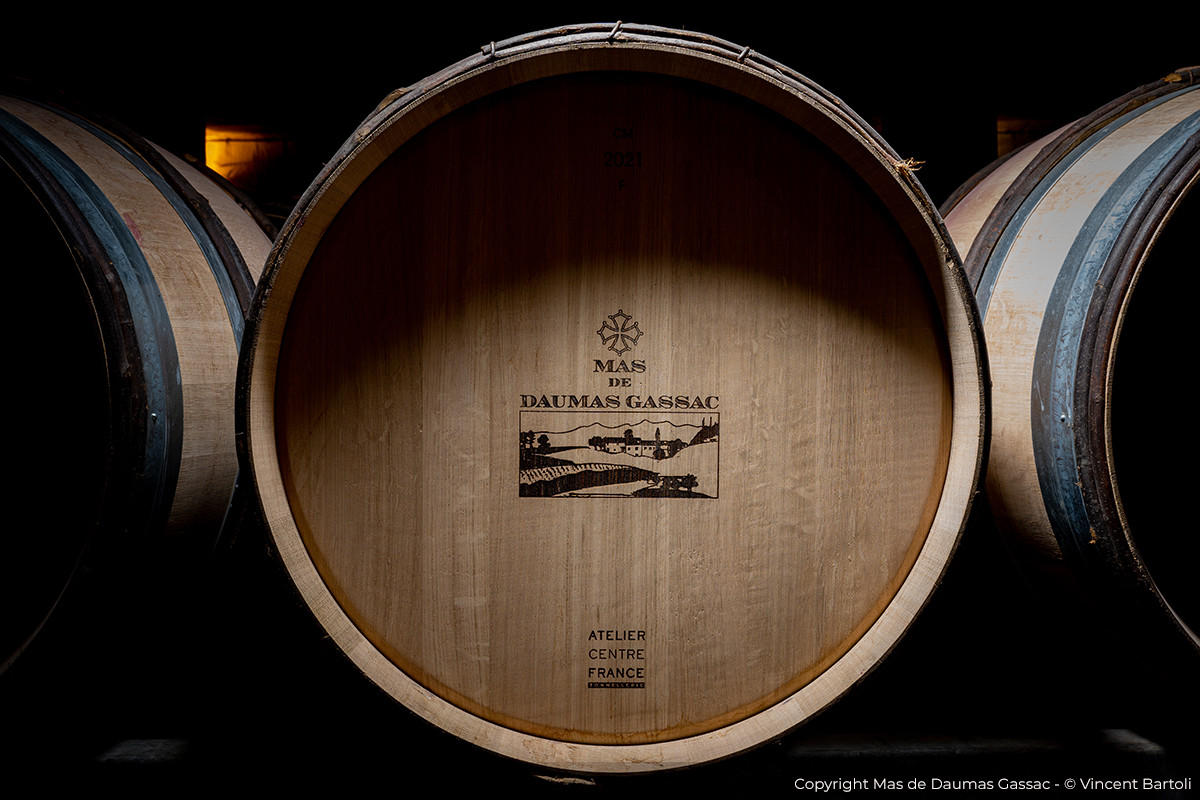
Photo: Vincent Bartoli, Mas de Daumas Gassac
And so to the wines. With the great variety of grapes produced there is no selection, no choosing the best or the flavours that work together in harmony. Here the adage that great wine is made in the vineyard is almost a religion. All the work is done in the vineyard and the grapes, if they are deemed good enough by the team of 60 harvesters (from 17 different countries no less) are picked. Once in the winery, if they make it through the thorough double (manual) sorting, then into the tanks they go.
Fermentation of different varieties happens together (co-fermentation) for the simple fact that there is not enough space for 24 different tanks in the winery. The process itself is gentle and though the wine needs tannins to support its long ageing potential the tanks are treated with care. Extraction is done infrequently but at the right moment - with perhaps only three pump-overs for the whole fermentation. These take place a good few days after the fermentation has begun though, to ensure maximum extraction.
Once complete, 50% of the wine ages in barrels for 18-22 months, one-seventh of those new. As with the vineyard, work goes into considering the choice of barrel, with two coopers selected after years of experimentation. The same is true of the corks; years of trials and discovery were undertaken before a firm decision on supplier was made. Here, nothing is left to chance.
The result is wines that are surprisingly consistent, not just vintage to vintage but even when mature, with minimal bottle variation.

We try the full range; it consists, after all, of only three wines. There is the red, a blend dominated by Cabernet Sauvignon which ages majestically, elegantly, softening and becoming more savoury with the decades. The white is broad and richly textured, with lanolin and honey and nut notes even with youth, with an almost tropical patina as it ages. And finally a rare frizzante rosé, made from Cabernet Sauvignon planted on flatter, warmer vineyards. Brightly fruited on the nose it is wonderfully dry and refreshing on the palate, and dangerously moreish. This is perfect with oysters – their shells still feeding the vines, providing a welcome boost of magnesium and calcium to the local soils.
There is much debate over what to compare the wines to though. Are they Bordelais in style? Rhône-like? Or perhaps they nod more towards Spain, the complex flavours emerging from a silky palate with age.
I ask Samuel how he would sum up the red. “It’s a Bordeaux-based blend, made in a Burgundian style from a southern climate,” he states confidently. And yes, that rings very true. The elegance and texture are far more Burgundian than one would expect, yet the ripeness gives away its Mediterranean origins.
Perhaps it’s a fool’s game though. Comparing one wine with another, trying to find a comparison. Of course the human brain loves shortcuts, easy wins so you know where to categorise a wine in your mind. The truth is these are beautiful wines that truly express exactly where they are from; 50 hectares of scattered vineyard in the Herault, from Mas de Daumas Gassac.
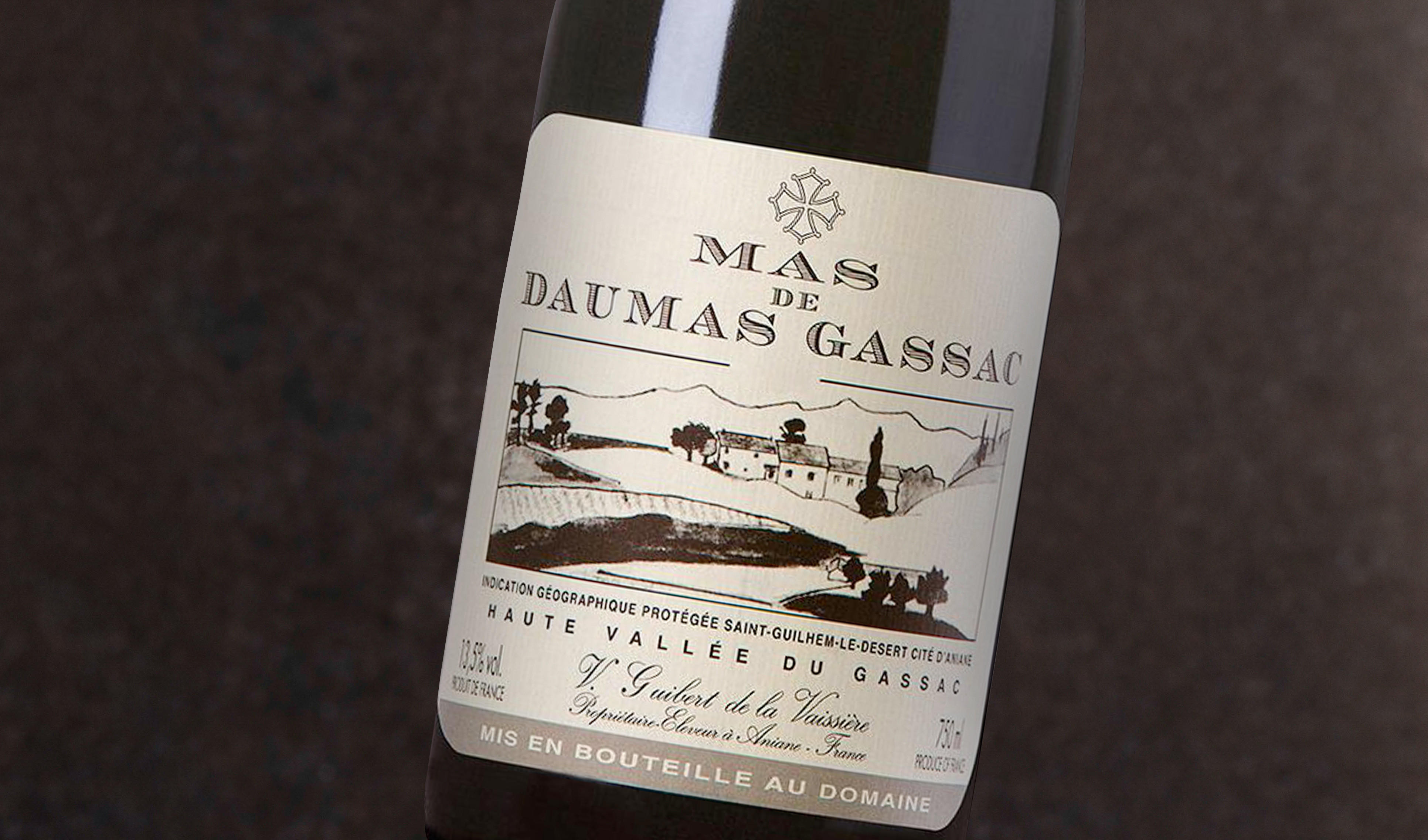
2023 Mas de Daumas Gassac
The 2023 Mas de Daumas Gassac red has just been released and is available to buy here. Though delicious now, with bright red fruit flavours and spice, and layers of ripe tannins, it has the potential to age elegantly for 20-25 years too. Serve with herb-crusted pork or lamb and a warm evening breeze.



